Online Music Marketing Guide
The music industry is one of the largest entertainment sectors, which consists of many companies and independent record labels. Over the years, with the introduction of the internet and social media, the music industry has found new ways to market and promote the service of music consumption. With the ever-developing technologies, the music industry has catered to the progression of the internet world. Throughout this blog, I will be creating an online music marking guide which identifies and evaluates the main types of online music marketing, resources, and distribution tools, which can be used by musicians to boost their online presence and music consumption.
The Big Three
The music industry was the first to be struck by the digital age and was struck harder than any other industry. Music became dominated by major music companies, consolidated into three major companies that controlled 70-80% of the music sold and consumed in Britain and the USA. Universal Music Group, Warner Music Group, and Sony. The internet and technology had bridged the direct gap between artists and fans and there is little need for the former manufacturing and marketing might of the music companies as intermediaries. “While digital technologies would sever to dismantle the power of major record companies, those same technologies empower individual recording artists to act independently like never before.” Rogers, 2013.
Over the years, the promotion of music through social media has become a ‘norm’ in today’s society. Music and technology have been entwined in a close relationship for millennia (Laterno, 2003). Social media gave artists and bands a new route to success as the idea of “being signed” to a large company was now a thing of the past, as social media allowed artists to take control of their own development and self-promotion. Social media is now one of the most used networks that have allowed a new way to directly connect artists to a wider online audience. For upcoming artists, social media has helped develop their fan base and allow them to communicate their products and services further afield.
Brand Values
As an upcoming artist in the music industry, it is important to understand your music and what exactly you’re promoting. To market and promote an object or service, you have to understand what your objectives are and who you’re promoting this too.
A question to ask yourself is, ‘What are the values of your organisation?’ To begin with, it is best to focus on brand image. Defining the identity of your product allows the targeted audience to better understand what they are consuming. Artists that fit into a specific genre usually relate to a specific audience. It is said that “Research shows that music can subconsciously affect our moods and influence our purchasing behaviours” (IDealogic® Lab,) along with influences on fashion sense. Taking this into consideration, it is important to create a brand image, using areas such as the logo for the band name, as a visual cue to connect to the audience in multiple ways. For example, Metallica are a metal rock band that use their band logo font to further accentuate this to potential consumers.

Business models and strategies
When promoting an artist, it is essential to have a marketing strategy that is appropriate to them specifically. An artist should have a story behind them and use different social media platforms with selective mediums (such as text or image) to communicate this to the audience. An unsigned act is building a new profile, getting press and building legitimacy.
In your strategy, once the identity of your artist is agreed upon, the understanding of your audience is the next vital step. When selling a product or service to an audience, it will have more success if the marketing scheme is directed at a target. To find this target audience, businesses can use a SWOT analysis (Strength, Weakness, Opportunities and Threats.) or PESTEL (Political, Economic, Social, Technological, Environment, Legal.) These are analytical techniques that allow you to analyse certain aspects of your business. Google Analytics also offers demographic information such as gender, age, and location. Understanding these areas allow you to focus specifically on the areas that need improving the most. Not only that, but Google Analytics offers a way to target “a specific group of people with shared characteristics who are most likely to be interested in your products or services.” (Hallissey 2017.) The use of analytical techniques allows a business to find a crossover in the audience. For example, if your music fits into the rock genre it is more likely that the audience for Nirvana will also take interest in your music.
Distribution Tools
Music marketing before the internet included radio/TV advertising, music press media, live music and merchandise. Although these distribution methods are still in use today, with the introduction of social media, more modern tools are taking over and being used more frequently.
In today’s society, the common use of a mobile phone means people have everything in one space. Platforms such as Facebook, Instagram, and Twitter provide a news feed consisting of updated posts from all around the world. These platforms allow text, image and videos which is great for an artist who can update fans on areas such as sneak-peeks into new music, album release dates and live events. Spotify and Apple Music are two major streaming services that allow the consumption of music. These platforms have quickly comprised the use of hard copy materials such as CD or vinyl as all music is now accessible in one place at all times. It’s quick, easy and efficient. The idea of hard copy materials is less important to an audience as younger fans prefer the quick tap of a phone to play their favourite song. However, if your target audience is an older generation, “If they are 55 years of age and older, you most definitely want to still print physical copies of your music” (Paulinski, 2020) as their online presence is not as large.
Although this may seem like a great advantage to the audience, having all music at the click of a button, according to NME, new figures show that “With an average payout of £0.009 per stream, it would take 970 streams on Amazon two earn minimum wage.” (NME, 2020.) Taking this into consideration, artists have to use social media to their advantage to get their music across a wider audience, to existing and new fans, to achieve as many streams as possible. Not only that, but musicians also have to make money in alternative ways, such as royalties, playing live, selling merchandise, and licensing fees. Social media has become an essential part of music marketing, forming a method to increase awareness and grow sales. Devising a strategy to post regular band updates, appropriate content that fans will take interest in, and allowing a personal connection between the audience and artist as ‘normal’ people, will allow musicians to steadily grow their online presence.
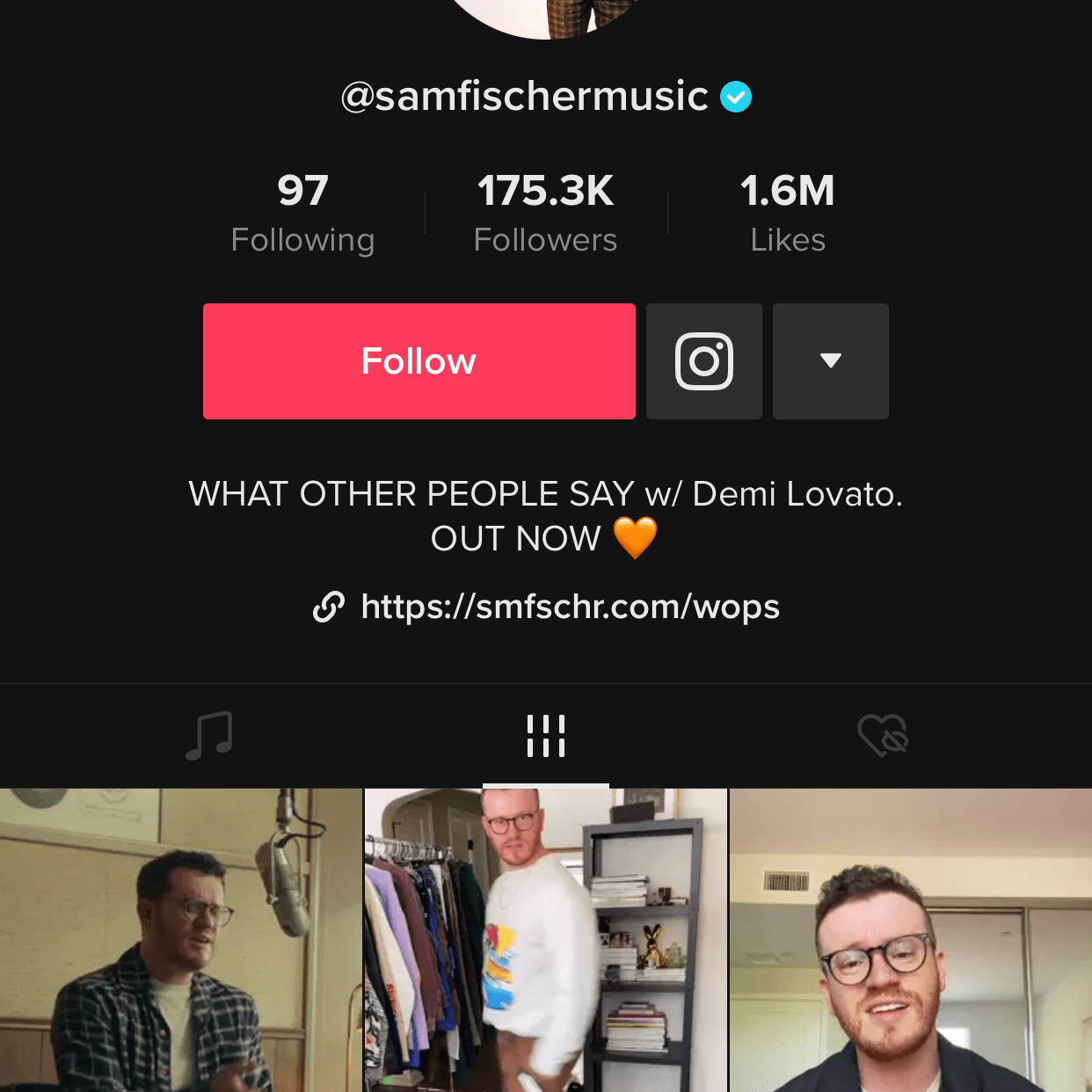
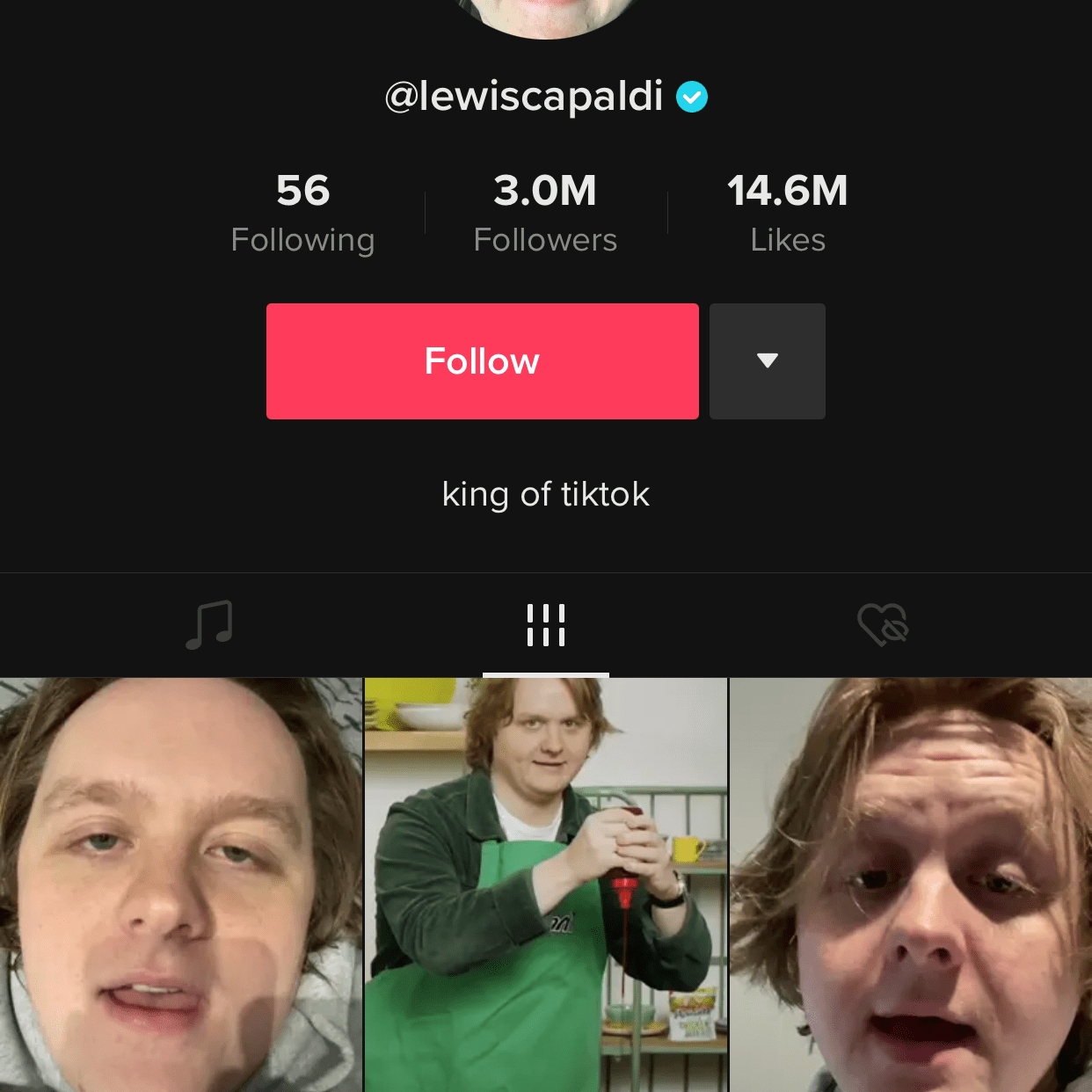
Over the past couple of years, Tiktok has made its way to the top as one of the most used social media platforms. Tiktok is a video-based platform that allows people to post a 60-second video. For popular musicians such as Sam Fisher and Lewis Capaldi, they post regular videos, both music and non-music related, as a way to interacting with their fans on a personal level. Comedy based content gets people more involved and they are more likely to return to the content if they enjoy it. Content that is high-quality and up to date is more appealing to a consumer.
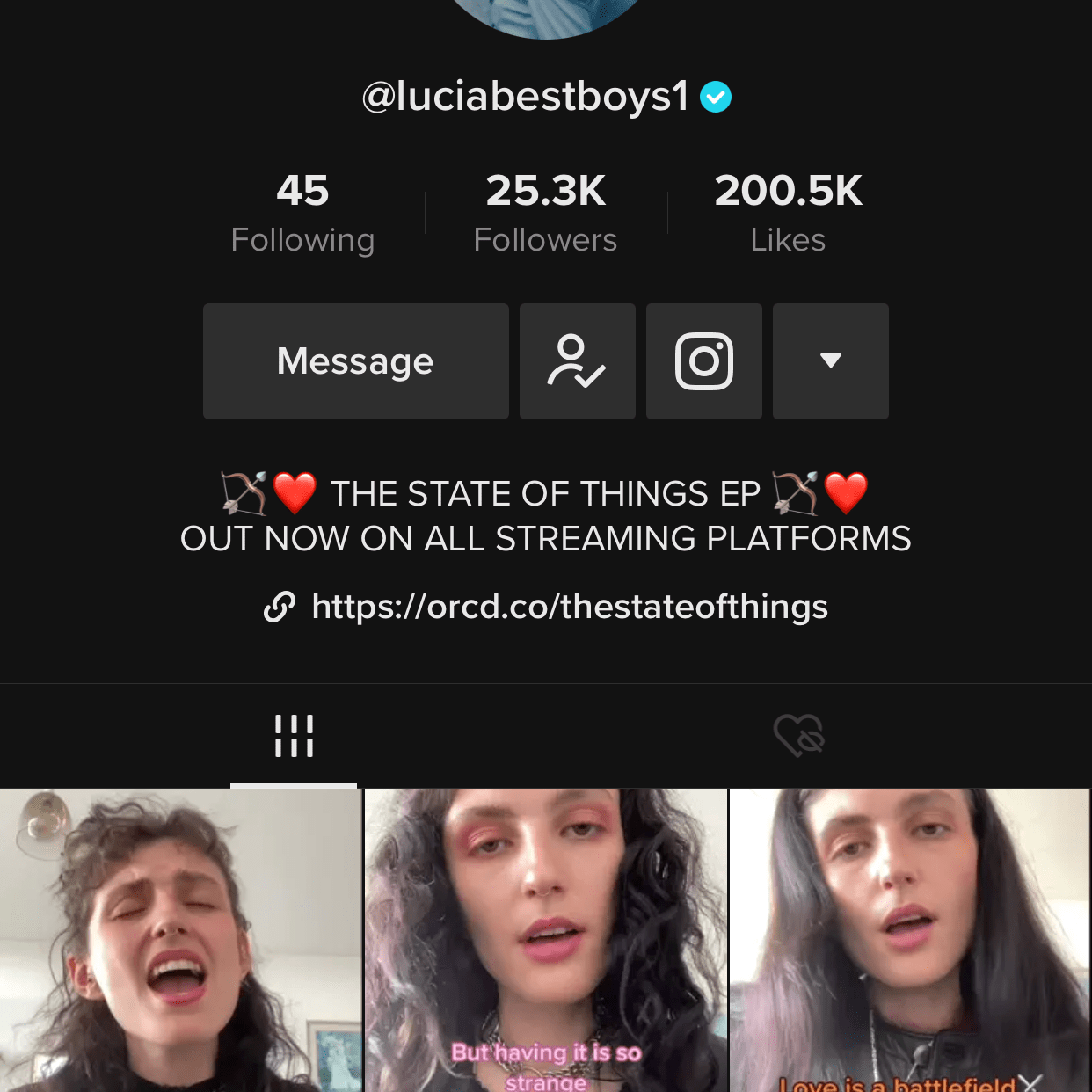
Aside from that, upcoming artists use Tiktok as a way to reach potential audiences. Tiktok has a ‘for you page’ which allows anyone to see your videos if it will relate to them. Upcoming musician ‘Lucia & the Best Boys’ have been using Tiktok to promote their EP, along with posting covers of well-known songs such as Fleetwood Mac to grab potential fans attention.
Case Study

Girl in Red
Girl in Red
As an example of how social media can affect the success of an upcoming artist, I have analysed the social media of an artist to put to use the online music marketing guide.
Girl in Red (Marie Ulven Ringheim) is a 22-year-old, indie-pop musician from Norway. Girl in red’s homemade bedroom pop singles about queer romance and mental health, lead to her musical success. Girl in Red has an account on all major social media platforms, including Tiktok.
Social Media
Instagram – 2.1 Million followers.
Facebook – 156,298 followers
Twitter – 294.8K Followers
Tiktok – 1.8 Million Followers
Facebook and Twitter
Throughout Facebook and Twitter, Girl in Red has published similar posts on each site. On Facebook, Girl in Red posts less frequently, mostly consisting of the promotion of her songs and live events, as well as updating information to the audience regularly. On the other hand, Girl in Red uses Twitter to publish the same posts, yet, using Twitter to post more personal tweets. In this case, Girl in Red uses Twitter more frequently as Twitter is a more popular social media site that her audience engage with more often. Although Girl in Red is aware of where her audience is, including which age group uses different social media sites, Girl in Red utilises both sites as a way to connect to a larger audience.
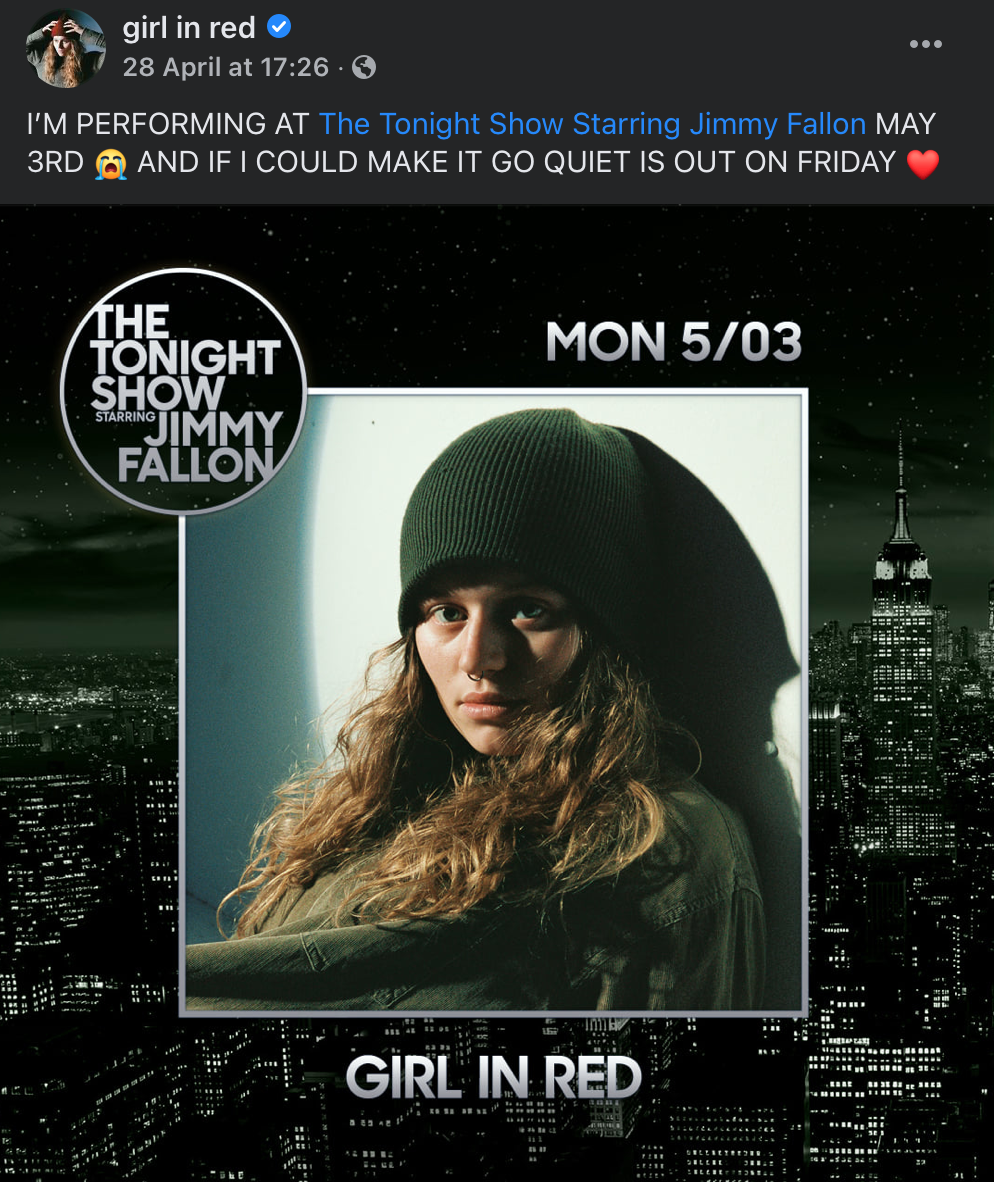
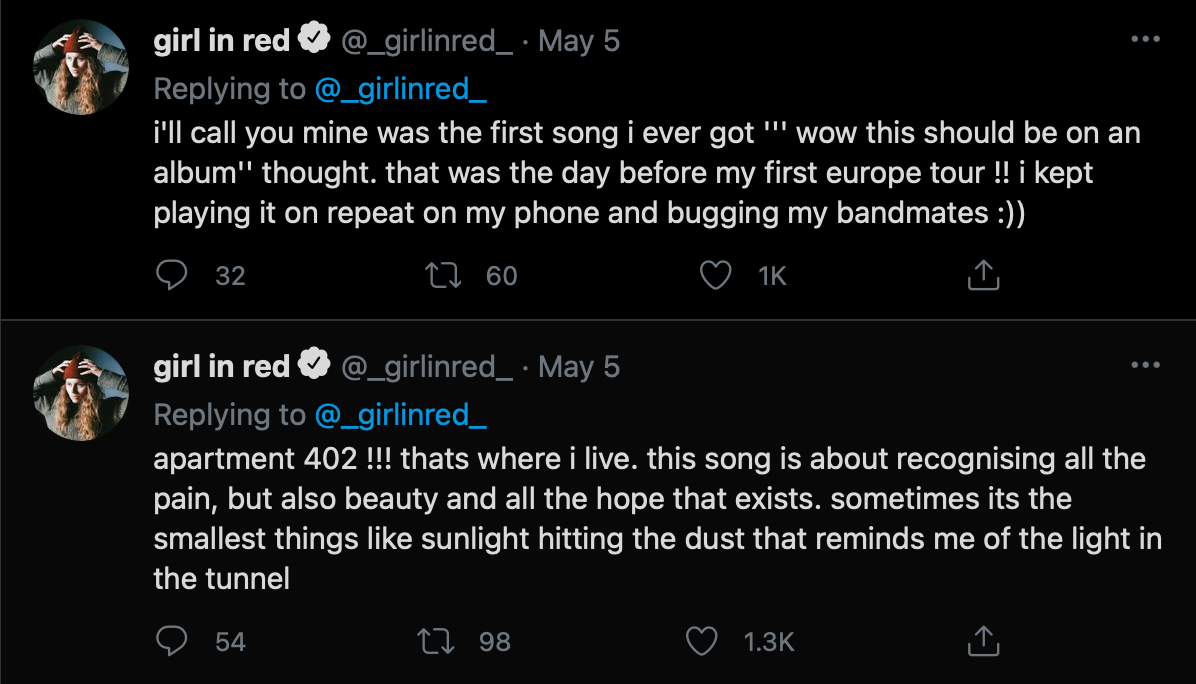
Facebook [Left] Twitter [right]
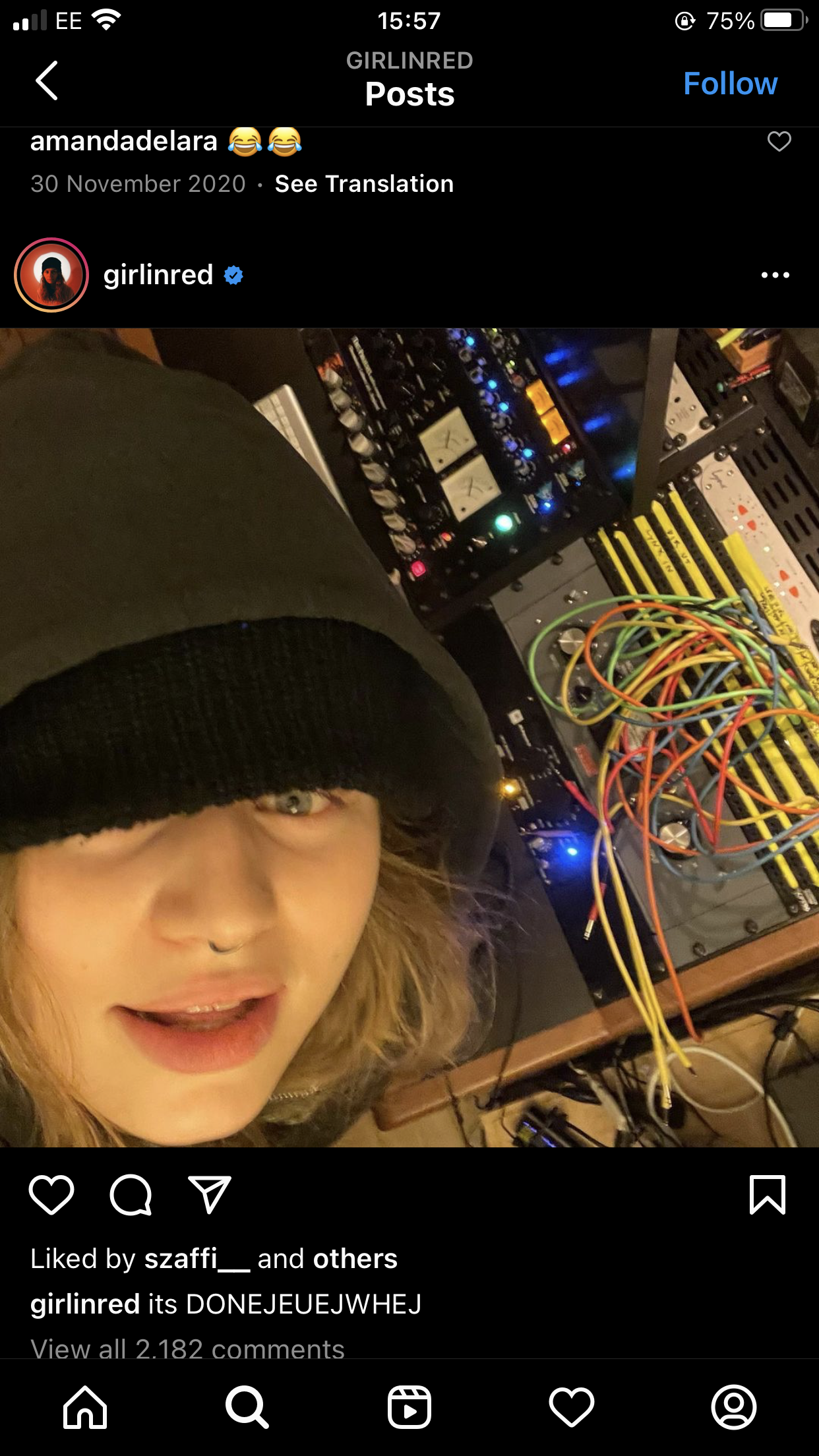
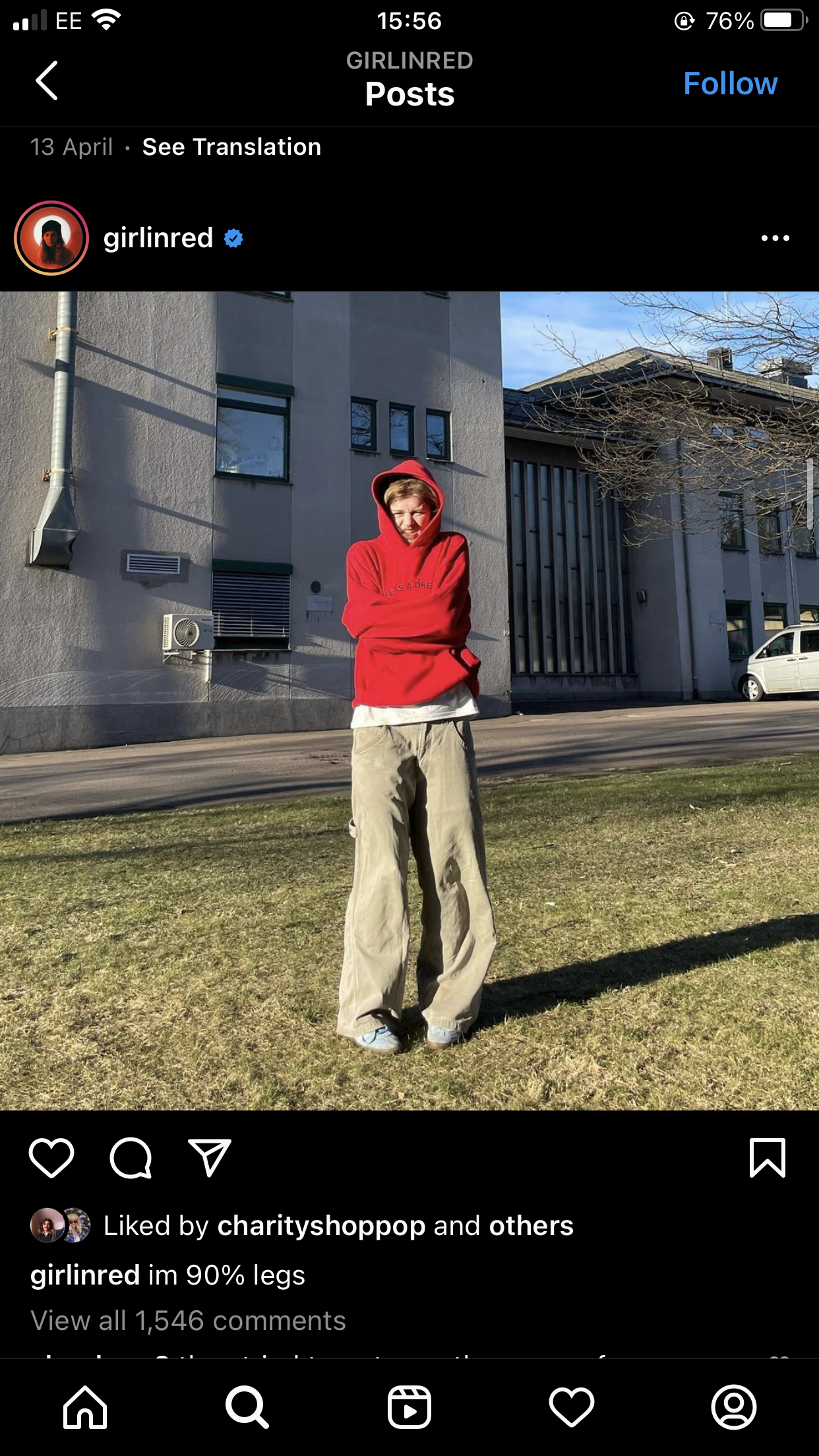
Instagram is one of the most followed accounts for Girl in Red’s Social media. Throughout her Instagram, Girl in Red focuses on being more personal with her audience, publishing posts that drive the attention of the audience away from the idea of her music. As Instagram is an image/video based platform, Girl in Red posts photos of herself on a more personal level, with captions that talk about how she’s feeling today, or something short and witty. This strategy creates a personal connection to the audience, allowing them to feel like they know the artist that is behind the music. The images below show the impact a simple post can have. The image on the left has received 2,182 comments as Girl in Red posts about her album being finished, however, the image and caption are very simple and short, which captures the point of the post.
YouTube
Girl in Reds YouTube is fairly simple, consisting of the audio recording of all her latest songs. A few of her video uploads also include live songs and iPhone voice recordings of when the songs were first written. Although her content is simply audio recordings, some of Girl in Red’s live performances allow the audience to hear the songs in a live, ‘raw’ acoustic setting that allows people to hear her talent at that moment. Voice recording also create a sense of privacy with which the audience is invited to engage with.
Website
One area in particular that Girl in Red uses well is a website. More specifically, Girl in Red uses an interactive space to allow the audience to interact, similar to a game. This method is interesting as many artist’s websites are blogs without an interactive space. Girl in Red has made her website fun, something a younger audience would enjoy, which makes it memorable. The website consists of tour dates, social media links and links to her music. It could be said the website is a portal to any other areas of Girl in Red’s social media and music.
Distribution
Girl in Red has many streaming services for her music, from Spotify to Amazon Music. With the use of mobile phones, music streaming services are now the most used method for the consumption of music. Girl in Red promotes these services throughout her social media, as well as upselling merchandise on Instagram and Twitter.
Conclusion
It is clear throughout the case study of Girl in Red that social media has played a great part in the development and success of her career. Now that social media has is allowing artists to take the reins and create their own path to success, it is important as an upcoming artist to use social media to your advantage. Understanding the marketing strategies that work on social media for similar artists (same genre etc) will most likely work for you. Adopting these strategies to fit your needs is what will make you stand out when building your online profile.
References
Rogers, J., n.d. The death and life of the music industry in the digital age. 1st ed. London: Bloomsbury Publishing, p.9.
Lab, I., 2021. The Psychology of Music and Its Influence on Consumer Behavior. [online] IDealogic® Brand Lab. Available at: <https://idealogicbrandlab.com/the-psychology-of-music-consumer-behavior/> [Accessed 5 May 2021].
Hallissey, T., 2017. What is a Target Audience, and why is it so Important?. [online] Long Island Web Design Company & Marketing Agency | Fat Guy Media. Available at: <https://www.fatguymedia.com/inbound-marketing/target-audience/> [Accessed 7 May 2021].
Daly, R., 2020. New figures show how many streams artists need to earn minimum wage. [online] NME. Available at: <https://www.nme.com/news/music/new-figures-show-how-many-streams-artists-need-to-earn-minimum-wage-2649715> [Accessed 7 May 2021].
Paulinski, S., 2020. Does It Still Make Sense to Release Physical Music in 2020?. [online] Blog.sonicbids.com. Available at: <https://blog.sonicbids.com/does-it-still-make-sense-to-release-physical-music-in-2020> [Accessed 7 May 2021].
 Skye McBride